You open Spotify and a name you've never heard of appears in your recommendations. A few weeks later, that same artist is everywhere: dominating your social feed, playing at every party, and climbing the Top 40.
It feels like a coincidence — or perhaps a stroke of marketing genius. In reality, it's neither. It's a calculated prediction. Spotify didn't just follow the trend; they saw the "quiet signals" months before the rest of the world caught on.
Here is how the world's largest streaming platform identifies a hit before it even has a name.
1. Beyond the Stream: Completion and "Quiet Signals"
Spotify doesn't care about raw stream counts as much as you think. Millions of plays can be bought or manufactured. Instead, the algorithm looks at behavioral signals that are much harder to fake:
- Completion Rate: Does the listener hear the song to the very last second, or do they skip after the first chorus?
- The "Save-to-Stream" Ratio: Out of everyone who heard the track, how many liked it or added it to a personal library?
- Repeat Obsession: How many users are putting the song on a loop?
When these metrics spike across different demographics simultaneously, the algorithm flags the artist as a high-potential breakout.
2. The Power of "Micro-Curation"
While editorial playlists like New Music Friday get the most glory, the real data is found in user-generated playlists.
When a new track starts appearing organically in thousands of personal playlists alongside established names like Drake, Taylor Swift, or Fred again.., Spotify's AI learns through "association." It recognizes that if you like Artist A (the superstar), you are statistically likely to love Artist B (the newcomer). This is called Algorithmic Affinity, and it's how "niche" sounds turn into global trends.
3. Velocity Over Volume
In the data world, Velocity is king. An artist with 10,000 listeners that are growing by 50% every week is far more valuable to an algorithm than a legacy artist with 10 million listeners that are stagnant.
Spotify measures momentum in real-time. If a track's daily growth rate outpaces the average for its genre, the "velocity trigger" kicks in. This automatically moves the song into testing grounds like Discover Weekly or Fresh Finds to see how a broader audience reacts.
4. Pattern Recognition (Not Opinions)
Spotify doesn't predict hits because a song is "good" — it predicts them because patterns repeat. The algorithm compares the growth curve of a new artist against the historical data of past breakouts. If the curve matches the early days of Billie Eilish or Olivia Rodrigo, the machine assumes the outcome will be similar and doubles down on its promotion.
The "Algorithm Lag": Why You Notice it Later
By the time you see an artist everywhere, Spotify has been "stress-testing" that artist in the background for weeks. You are seeing the final result of a massive data-filtering process.
The problem? By the time the algorithm "allows" you to hear the artist, they are already trending. You aren't a pioneer; you are part of a targeted rollout.
The Tune Tracker Edge: Real Fans Get There First
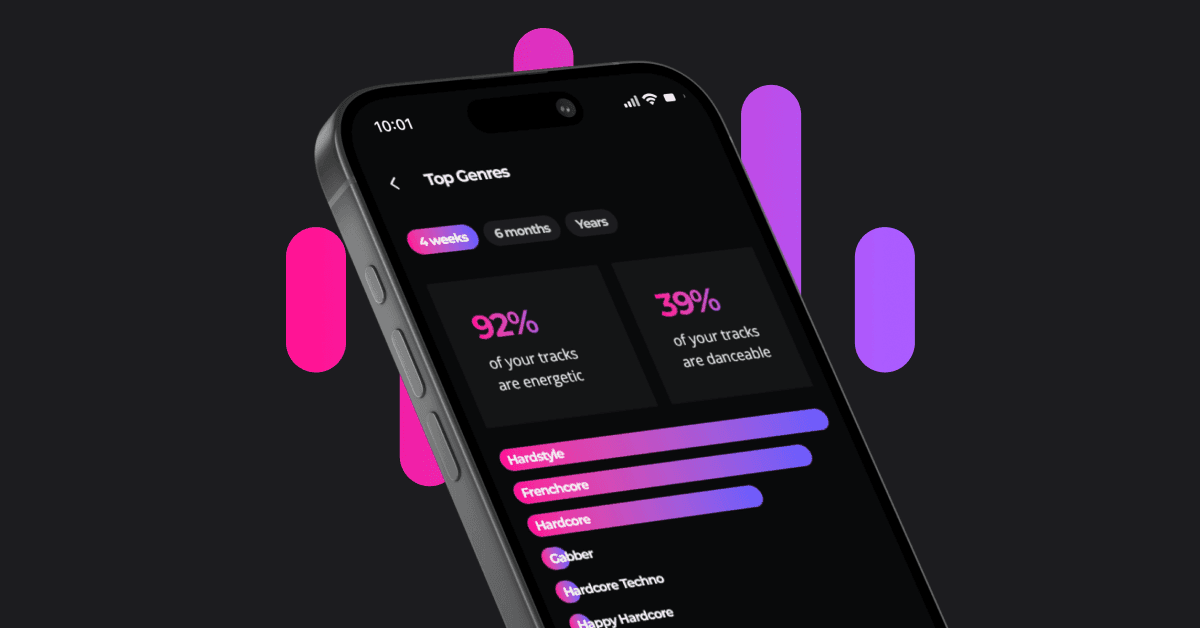
Spotify's job is to predict what the masses will like. Tune Tracker's job is to tell you what your favorite artists are doing right now.
While Spotify is busy testing patterns and analyzing momentum to see if a song is "worthy" of your feed, Tune Tracker gives you a direct line to the source. You get notified the second an artist you follow drops a track — long before the algorithm decides to boost it.
Trends are interesting, but real connection starts before the hype. Tune Tracker ensures you aren't just following a trend; you are following the artist.
Conclusion
Spotify doesn't have a crystal ball; it has the world's largest dataset of human behavior. It identifies trends by analyzing velocity, association, and completion.
With Tune Tracker, you don't have to wait for the data to reach a consensus. You are already listening while the rest of the world is still waiting for their "Discover Weekly" to tell them what's cool.